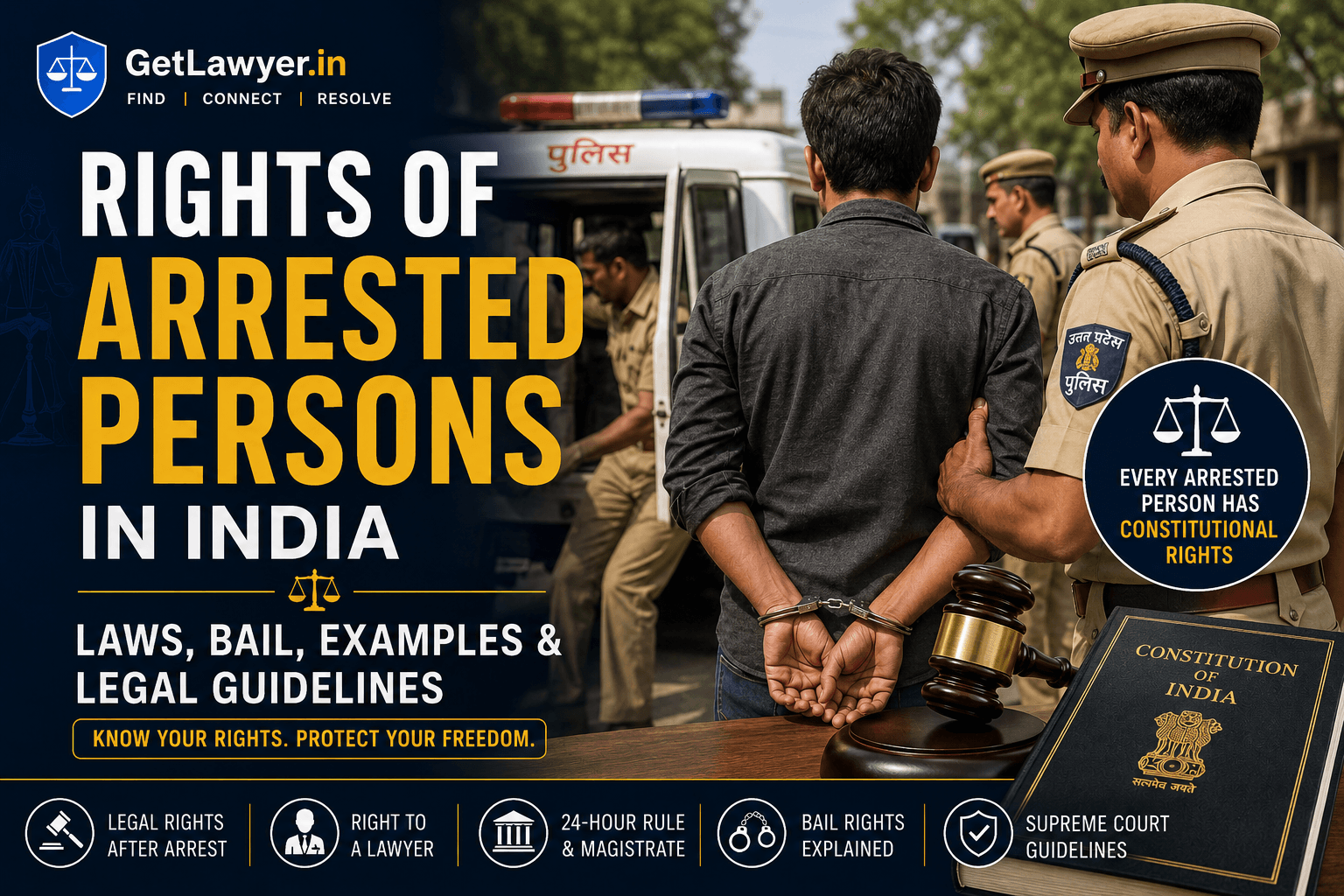
Rights of Arrested Persons in India: Laws, Bail, Examples & Legal Guidelines
Rights of Arrested Persons in India: Laws, Bail, Examples & Legal Guidelines
India is a democratic country where every citizen has fundamental rights — even when a person is arrested. Many people do not know their legal protections during police arrest, detention, or interrogation. Understanding these rights can help prevent misuse of power and protect innocent people from illegal harassment.
In this article, we explain the rights of arrested persons in India, important legal provisions, bail rules, Supreme Court guidelines, and real-life examples in simple language.
What Does “Arrest” Mean?
An arrest means a person is legally taken into police custody because they are suspected of committing a crime. However, arrest does not mean the person is guilty. Every accused person has the right to a fair investigation and trial.
Under Indian law, police cannot arrest someone illegally or without following proper procedures.
Constitutional Rights of Arrested Persons in India
The Constitution of India provides several protections to arrested individuals.
1. Right to Know the Grounds of Arrest
Under Article 22(1) of the Constitution and Section 47 of the Bharatiya Nagarik Suraksha Sanhita (BNSS), the police must clearly inform the person why they are being arrested.
A person cannot be kept in custody without knowing the charges.
2. Right to Remain Silent
An accused person has the right against self-incrimination under Article 20(3) of the Constitution.
This means:
- Police cannot force someone to confess.
- Nobody can be compelled to give evidence against themselves.
3. Right to a Lawyer
Every arrested person has the right to consult and be defended by a lawyer of their choice.
If the person cannot afford a lawyer, free legal aid must be provided by the government through legal services authorities.
Important Laws:
- Article 22(1) of the Constitution
- Legal Services Authorities Act
4. Right to Be Produced Before Magistrate Within 24 Hours
Police must produce the arrested person before a magistrate within 24 hours of arrest.
Keeping someone in custody beyond 24 hours without court permission is illegal.
Important Provisions:
- Article 22(2)
- Section 58 BNSS
Right to Bail in India
Bail means temporary release from custody while the case continues in court.
Types of Bail
1. Regular Bail
Granted after arrest by the court.
2. Anticipatory Bail
A person expecting arrest can apply for anticipatory bail before being arrested.
3. Interim Bail
Temporary bail granted for a short period.
Bailable and Non-Bailable Offences
Bailable Offence
- Bail is a legal right.
- Police or court must grant bail.
Examples:
- Minor fights
- Simple hurt cases
Non-Bailable Offence
- Bail depends on court discretion.
Examples:
- Murder
- Rape
- Serious fraud
Important Supreme Court Guidelines on Arrest
The Supreme Court of India has issued several guidelines to prevent illegal arrests and custodial torture.
D.K. Basu vs State of West Bengal (1997)
This landmark judgment laid down important arrest procedures.
Police Must:
- Wear identification badges
- Prepare arrest memo
- Inform family members
- Conduct medical examination
- Maintain arrest records
Failure to follow these rules can lead to legal action against police officers.
Rights of Women During Arrest
Indian law provides additional protections to women.
Important Rules:
- Women should generally not be arrested after sunset and before sunrise.
- Female officers should conduct the arrest.
- Medical examination must be done by female medical practitioners when possible.
Rights of Juveniles (Children)
If a child below 18 years is accused of an offence:
- They are treated under the Juvenile Justice Act.
- They are not kept in regular jail with adult criminals.
- Child-friendly procedures must be followed.
What to Do If Someone Is Illegally Arrested?
If police arrest someone illegally, the family or lawyer can:
- File a Habeas Corpus petition in High Court or Supreme Court
- Seek compensation for illegal detention
- File complaint against police officers
- Approach Human Rights Commission
Example of Illegal Arrest
Example:
A person is picked up by police without warrant, family is not informed, and the person is kept in custody for 2 days without being produced before a magistrate.
This is illegal because:
- 24-hour rule was violated
- Family was not informed
- Proper arrest procedure was not followed
The accused can challenge the arrest in court and seek legal remedies.
Important Guidelines for Citizens During Arrest
Do:
✔ Stay calm and cooperate peacefully
✔ Ask the reason for arrest
✔ Ask for arrest memo copy
✔ Contact a lawyer immediately
✔ Inform family members
Don’t:
✘ Resist physically
✘ Sign blank papers
✘ Give forced confession
✘ Panic or argue aggressively
Can Police Arrest Without Warrant?
Yes, police can arrest without warrant in certain cognizable offences such as:
- Murder
- Theft
- Kidnapping
- Serious assault
However, police must still follow legal procedures and constitutional safeguards.
Custodial Violence and Human Rights
Custodial torture and fake encounters are serious violations of human rights.
Indian courts have repeatedly stated:
“Police power cannot override constitutional rights.”
Any custodial violence can result in:
- Departmental action
- Criminal prosecution
- Compensation to victims
Conclusion
The rights of arrested persons are essential for protecting democracy, justice, and human dignity in India. Arrest does not mean guilt, and every individual has constitutional protections against illegal detention, torture, and misuse of authority.
Knowing these rights helps citizens protect themselves and ensures that law enforcement works within legal boundaries.
Whether it is the right to bail, right to a lawyer, or the 24-hour production rule, every person should be aware of these legal safeguards.
Frequently Asked Questions (FAQs)
Can police arrest without evidence?
Police may arrest based on reasonable suspicion in cognizable offences, but arbitrary arrest is illegal.
Can police beat an accused person?
No. Custodial torture is illegal and violates constitutional rights.
Is bail a right in all cases?
Bail is a right in bailable offences, but in non-bailable offences it depends on court discretion.
Can a person call family after arrest?
Yes. Police must inform relatives or friends about the arrest.
What if police violate arrest rules?
The accused can approach the court and seek legal remedies including compensation.
Keywords
- Rights of arrested person in India
- Arrest laws India
- Bail rights
- Constitutional rights after arrest
- Police arrest procedure India
- Legal rights of accused
- Anticipatory bail India
- Illegal arrest laws
- Supreme Court arrest guidelines
- BNSS arrest rules
Related articles
More reads you may find useful